As an Amazon Associate, this website earns from qualifying purchases.
The best small 3D printer must fit the work, not just the shelf. Check the file you plan to make and the room needed to run the machine. Include spool loading and routine care. For resin, plan the wash and cure area as well as the printer.
These choices include two filament printers and one resin printer. We do not name an overall smallest setup from a build cube or a closed product photo. A machine that fits a surface can still lack room to operate. Read the exact installation guide before choosing a place for it.
#1. Bambu Lab A1 mini + LED Lamp Kit
- 180 × 180 × 180 mm stated build cube.
- 347 × 315 × 365 mm stated unit size.
- Automatic calibration.
Keep in mind: Unit size excludes working clearance; plan bed, spool, cable and plate access from the setup guide.
The A1 mini lists a 180 mm build cube. Its stated machine size is 347 × 315 × 365 mm. Those are separate measures. The first helps check the sliced job; the second is only a starting point for the physical layout.
Automatic calibration is listed. PLA and PETG are among the maker's ideal materials, while ABS and ASA are not recommended. Choose a permitted spool and profile before planning the job. The lamp kit in this exact offer does not change the build cube or establish the working clearance.
Check the moving bed, spool position and cable route in the setup guide. Leave access to load filament and remove the plate as directed. Do not treat the listed unit size as permission to operate inside a tight cabinet.
#2. Flashforge Adventurer 5M
Flashforge Adventurer 5M
Our verdict:
Larger filament build cube
Compare it when the job needs its larger stated cube; confirm the installation space before choosing a surface.
View on Amazon - Build volume: 220 × 220 × 220 mm.
- CoreXY structure with automatic leveling.
- Detachable nozzles support nozzle changes.
Keep in mind: Do not use build volume as machine footprint. TPU requires the specified 0.6 mm nozzle.
The 5M lists a 220 mm build cube. That is larger on each axis than the A1 mini's. Compare it when the complete sliced job needs that space. The build cube does not tell you the table depth or overhead access it needs.
The maker lists a CoreXY structure, automatic leveling and detachable nozzles. Its material table pairs PLA and PETG with a 0.4 mm nozzle, and TPU with a 0.6 mm nozzle. Check the exact nozzle and profile before changing material.
ABS-series filaments are excluded. Do not transfer the Pro's enclosed shell or material support to this model. Confirm the current installation dimensions and access needs before choosing a shelf; we do not infer them from its build cube.
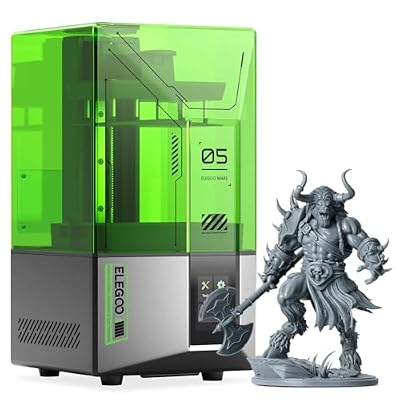
#3. ELEGOO Mars 5
Elegoo Mars 5
Our verdict:
Separate resin workflow
Compare it for a supported resin job only when the complete handling, wash and cure area can be provided.
View on Amazon - 143.43 × 89.6 × 150 mm stated build space.
- 230 × 230 × 433.5 mm stated printer size.
- MSLA resin printing and automatic leveling.
Keep in mind: The unit size does not include cover access, liquid handling, wash/cure equipment or waste storage.
The Mars 5 lists a 143.43 × 89.6 × 150 mm build volume. Its maker gives a 230 × 230 × 433.5 mm printer size. The unit's smaller base dimensions do not describe the complete resin workspace.
It uses MSLA resin printing with a 405 nm light source. Automatic leveling and a self-check are listed. Check the supported model layout against each build axis. A part that fits either filament printer may not fit this different build shape.
Plan access to lift the cover and handle the platform as directed. Plan resin storage as well as washing and post-curing. Read the exact resin and wash-liquid safety sheets and resolve the waste route before buying. A small closed unit is not a complete process area.
Factors to consider when choosing the best small 3D printer
Compare the two kinds of size
Scroll for more →
Unit sizes are not clearance figures. The A1 mini specifications and Mars 5 specifications describe those units, while the actual setup needs its own layout. Do not substitute a shipping box size for either measure.
Check one real sliced file
Use the correct machine profile and the final model scale. Inspect the pose and supports. Check any brim too. Check the complete job, not just the bare shape. Keep the intended file version so that a later change does not silently alter the fit.
Decide whether a split part is acceptable before choosing a smaller build area. A split adds joining and finish work. Check access to the seam and any mating parts. Do not shrink one section alone if it must fit another piece.
Measure the operating layout
Measure the surface and overhead space you can use. Check the current maker guide for the full range of motion and cable needs. Include any separate spool holder or feeder in the exact setup. Mark the proposed layout before moving the machine into place.
Check how a door, cover or plate opens or comes out. Leave room to use the controls without reaching through moving parts. Follow the required access rules around heated parts. A shelf that holds the feet may still be too small for those tasks.
Leave access for loading and care
Find the loading path and the documented routine care steps. Check whether you can replace a spool without shifting the machine. Keep access to the named cleaning and service points. Read the shutdown and cooling steps before planning how to reach a part.
Keep supplies within the wider workspace plan. Filament storage takes room too, even when it is not on the machine. A narrow table should not force a cable or material path into an unsuitable position. Use the exact setup instructions rather than copying a staged photo.
Give the resin process its own area
The Mars 5 is a different process from the two filament machines. Lay out the path from bottle to printer, then to wash and cure. Keep clean controls apart from wet handling. The selected material and equipment instructions govern those stages.
Use our resin beginner guide to plan the whole process. A covered printer or low-odor label does not establish room controls. Resolve the handling and waste plan before treating a small printer as a suitable choice for the available space.
How We Picked
We checked three distinct complete-printer offers for qualifying new US availability. We compared their supported build areas and processes. Current maker pages provide unit dimensions for the A1 mini and Mars 5. Confirm the 5M installation dimensions with the maker before using it to choose a shelf.
We have not tested these setups on a desk or measured working clearance. Listed unit dimensions are not a fit guarantee. The exact package, installation guide and chosen material still need checking before ordering. Offers can change.
Verdict on the best small 3D printer
Choose the best small 3D printer after checking both the file and the operating layout. Compare the A1 mini's 180 mm cube and the 5M's larger 220 mm cube for filament projects. Compare the Mars 5 only with a complete resin process. Leave room to load and remove prints. Keep service access clear.