As an Amazon Associate, this website earns from qualifying purchases.
The best FDM 3D printer depends on the filament and file you plan to use. Start with the permitted material. Then compare the space the sliced job needs and the steps to set up and care for the machine.
#1. Bambu A1 for automatic calibration
- Automatic Z-offset and bed leveling
- 256 × 256 × 256 mm build volume
- Quick-swap nozzle
Keep in mind: The maker does not recommend ABS, ASA, PC, PA, PET or carbon and glass fiber reinforced polymers.
The A1 handles Z-offset and bed leveling through automatic calibration.
Treat its quick-swap nozzle as a separate care feature. Automatic bed setup does not replace the need to follow service instructions.
The maker does not recommend ABS or ASA. Read its full material limits before choosing a spool.
Multicolor work needs AMS lite. It comes with the Combo or can be bought on its own.
Third-party standard G-code slicers may lack some advanced features.
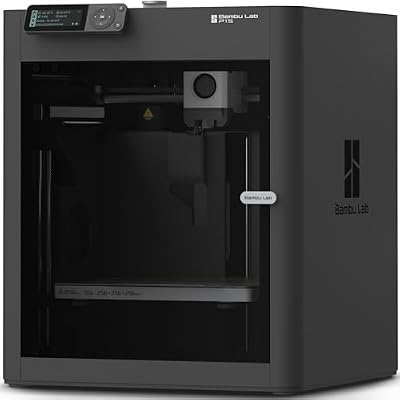
#2. Bambu P1S for enclosed material projects
- Enclosed plastic and glass shell
- ABS and ASA listed as ideal materials
- 256 mm build space on each axis
Keep in mind: Carbon and glass fiber reinforced polymers are not recommended.
The enclosure and listed ABS and ASA support are the main reasons to shortlist this model.
The material guidance lists PA and PC as capable choices rather than ideal choices.
Carbon or glass fiber filled materials are not recommended.
Multicolor work needs an AMS setup.
#3. Flashforge Adventurer 5M for nozzle flexibility
- CoreXY structure with automatic leveling
- Direct drive extruder
- Detachable nozzles
Keep in mind: The manufacturer says ABS series filaments are incompatible.
The 5M has a direct drive extruder and detachable nozzles. Automatic leveling is also listed.
The maker table pairs PLA and PETG with a 0.4 mm nozzle. It lists TPU with a 0.6 mm nozzle.
The maker says ABS series filaments are not compatible.
Factors to consider when choosing the best FDM 3D printer
Start with materials
Choose the type of filament before making a shortlist.
For ABS projects, P1S lists that material as ideal. A1 does not recommend it. The 5M maker says ABS series filaments are not compatible.
Compare space along every axis
The A1 and P1S state 256 mm along each build axis. The 5M states 220 mm.
Use your largest intended part to decide whether that build-space difference matters.
Separate setup from maintenance
The A1 explicitly covers Z-offset and bed leveling. Both other picks also list automatic leveling.
Read the steps to replace the nozzle as well as those for bed setup.
Check the nozzle and material pairing
The 5M has a nozzle condition for TPU. Check that the exact kit includes what the project needs. Do not count an optional part as included.
Take a file through the full workflow
FDM uses filament to build a part. Buying the machine is one step in that process. Use a slicer profile for the exact printer and nozzle, then inspect the prepared job before starting it.
Check the whole sliced pose, including any supports and print aids. A part that fits along one axis can still exceed the useful space on another. If you must split it, decide how to join the sections before choosing the machine.
Keep a copy of the file and the settings used for a job. When changing a nozzle or material, check the profile again. A printer's listed limit is not a setting for every spool.
The slicer guide explains file preparation. Use the first-filament guide to check a spool. If you are comparing processes, read the resin workflow guide before treating a resin machine as the same setup.
Count the work around a print
Read the exact plate-care and part-removal instructions. Find the nozzle assembly and the maker’s steps for replacing it. A shared opening size does not make another hotend assembly the right part.
Plan access for loading and routine care, beyond the machine’s outer size. Leave the working room required by the setup guide. A larger build cube is useful only when the file needs it and the complete setup suits the room.
Do not choose from a headline speed alone. The time shown for your sliced file is a planning estimate. We have not timed that job on these machines or compared their finished surfaces. Choose around the workflow you can manage and the material the maker permits.
How We Picked
We checked the exact selected configurations for new US offers below this site's strict ceiling. We compared their supported features with the reader's task. The links refer to those configurations, so check the package before ordering. Offers can change.
We have not tested these products. Specifications do not establish measured finish, speed or suitability for every project. Use the exact maker instructions for the machine and material.
Verdict on the best FDM 3D printer
Choose the best FDM 3D printer for a permitted material and a real sliced job. Compare P1S for its documented ABS and ASA path. Compare A1 for its build cube and automatic setup. Consider 5M when its stated space and the required nozzle suit the job.